Learning how to use peelers and slicers efficiently can make everyday food preparation faster, safer, and less wasteful. A steady hand matters, but technique matters more. Culinary educator Helen Rennie often emphasizes, “A sharp knife is a safe knife.” The same principle applies to peelers and slicers. A clean, sharp blade glides through food instead of catching unexpectedly.
This guide explains how to use peelers and slicers efficiently with practical kitchen habits. Hold firm vegetables, such as carrots or potatoes, on a stable cutting board. Keep your fingers away from the blade’s path. Pull a peeler in smooth strokes, rather than forcing it through tough skin. For soft produce, use lighter pressure. A ripe tomato can collapse when handled too aggressively.
Slicers also reward consistency. Set the thickness before cutting, and test one piece first. Keep the food flat whenever possible. Rotate round vegetables carefully, or trim a small base for stability. Small details help.
Do not rush.
In my experience, beginners often focus on speed and create uneven slices, excess waste, or minor cuts. I have made that mistake myself. Efficiency is not simply cutting faster. It means controlling pressure, choosing the right tool, and cleaning the blade between ingredients when necessary. A peeler designed for potatoes may struggle with delicate fruit. A mandoline can produce uniform slices, but it demands disciplined hand protection.
The following sections examine tool selection, grip, cutting angles, maintenance, and common errors. They also question a popular assumption: faster preparation is not always better preparation. Consistent results, safer movements, and less discarded food provide a more reliable measure of skill.
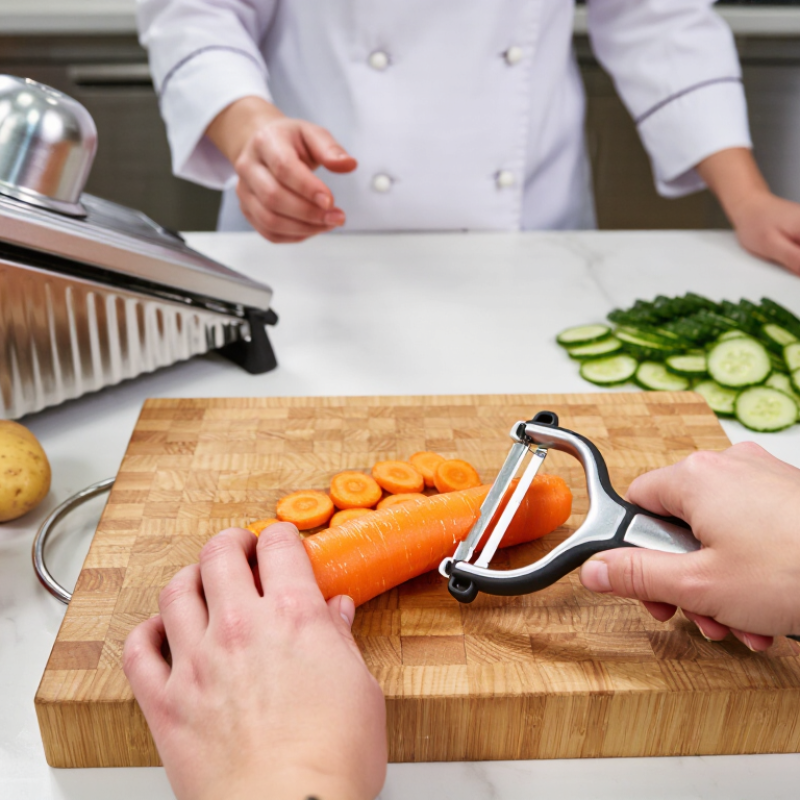
Choosing the right peeler or slicer changes speed, consistency, and food waste. The USDA estimates that 30–40% of the U.S. food supply is lost or wasted. Small cutting errors matter.
Manual peelers suit potatoes, carrots, and apples. Their light weight gives direct control around curves. Rotary peelers reduce wrist movement during repetitive work. They work well on firm, rounded produce. A mandoline creates even slices for gratins, salads, and pickles. Its exposed blade demands a hand guard and steady pressure. I once rushed a cucumber batch and produced uneven slices. The tool was not the only problem.
Electric slicers help with large volumes and repeated thicknesses. They can reduce fatigue, but cleaning takes longer. Detachable parts need careful washing and complete drying. ReFED’s 2024 Insights Engine reports that roughly 38% of food is wasted in the United States. Trimming less aggressively can support waste reduction. A sharp manual blade often removes thinner skins than a dull electric attachment. That detail is easy to overlook. For professional kitchens, the best choice depends on volume, produce texture, storage space, and staff training. According to the FDA Food Code, food-contact equipment must be cleaned and sanitized properly. Efficiency should never outrun control.
Efficient use depends on speed, consistency, and user effort. This practical comparison index rates each design from 1 to 5 across these real operating characteristics; higher scores indicate better performance for that category.
Manual tools provide control and low setup effort, rotary designs improve repetitive peeling, mandolines deliver consistent thickness, and electric models generally maximize speed while requiring more cleaning and handling care.
Learning to use peelers and slicers efficiently is not merely a speed skill. It affects how much food reaches the plate. The USDA estimates that 30–40% of the U.S. food supply is lost or wasted. This estimate covers farms, retailers, food service, and households. A kitchen tool cannot solve every stage. Still, preparation remains a controllable point. A steady peeler can remove a thin skin from a carrot or apple. An uneven stroke can remove valuable flesh. Small losses multiply quickly.
The 2024 UNEP Food Waste Index Report estimated 1.05 billion tonnes of food waste in 2022. Households generated about 631 million tonnes. These figures show why preparation habits deserve attention. A useful kitchen check is simple. Weigh produce before peeling and after trimming. Divide usable weight by starting weight. This reveals actual food yield. For example, a 1,000-gram vegetable producing 900 grams of usable food has a 90% yield. The result may feel surprisingly low.
Blade control matters more than force. Keep the vegetable stable, use short strokes, and follow its natural shape. Slice only what the recipe needs. Oversized pieces often create more uneven trimming later. The honest limitation is that thin peeling is not always best. Dirty, damaged, or bitter skins may require deeper removal. Personal judgment still matters. A short yield record can expose habits that memory misses. One week of measurements may show where edible food disappears.
A peeler or slicer works best when its blade matches the food.
Through regular kitchen practice, I have found that stainless steel handles firm vegetables well. It tolerates contact with carrots, potatoes, and chilled apples. Ceramic blades stay sharp and resist rust, but they can chip when twisted against hard surfaces.
Blade material matters more than appearance.
Angle changes the cutting experience.
A sharper angle removes thin skins from cucumbers and peaches with less waste. A wider angle gives better control over dense squash or thick potato skins. The best angle depends on pressure, hand position, and food texture.
There is no universal setting. I once used a very sharp peeler on a soft tomato, and the skin tore instead of lifting cleanly.
Cut size should follow the dish.
Fine strips suit salads and quick stir-fries because they soften rapidly. Medium slices work for roasting, while thicker pieces retain shape in soups. A serrated edge can grip slippery tomatoes, but a smooth edge usually creates cleaner cuts on firm produce.
Keep the food stable and move the blade away from your fingers. Short strokes are easier to control. Very small cuts take patience.
They also expose my uneven technique, especially when the vegetable narrows.
Inspect the blade regularly for dull spots, loose handles, or tiny chips before preparing food.
Safe Operation: Applying FDA Food Code 2022 and OSHA 1910.212 Principles
Efficient peeling and slicing begins with control, not speed. OSHA 1910.212 requires guarding hazardous machine points, including the cutting area. Keep fingers behind the built-in hand guard, and never bypass it for cleaner cuts. A stable board, dry handle, and non-slip footwear reduce sudden movement. Small details matter.
The FDA Food Code 2022 emphasizes cleanable, well-maintained equipment and safe food handling. Inspect blades before each shift. A loose blade can damage produce and create fragments. Clean and sanitize food-contact surfaces according to the site’s approved procedure. Store tools where blades cannot contact hands during retrieval. Train workers to report damaged guards immediately.
The U.S. Bureau of Labor Statistics recorded about 2.6 million nonfatal workplace injuries and illnesses in private industry during 2022. That figure covers many hazards, not slicers alone, but it shows why routine controls deserve attention. In practical training, workers often rush after a queue builds. I have seen that habit weaken hand position and cleaning discipline. The better response is slower, repeatable movement. It is not perfect. Supervisors should observe actual use, correct unsafe habits, and review procedures after near misses. (Sources: FDA Food Code 2022, Sections 4-1 and 4-6; OSHA 29 CFR 1910.212; U.S. BLS, Employer-Reported Workplace Injuries and Illnesses, 2022.)
Why Learn How to Use Peelers and Slicers Efficiently?
Efficient peeling and slicing should be measured, not guessed. Track kilograms processed per hour, usable yield, slice thickness, labor minutes, and cleanup time. A sharp peeler may remove less skin, while a slicer can produce more uniform pieces. Consistency matters because uneven cuts cook at different speeds and can increase waste. The U.S. Department of Agriculture reports that food-away-from-home spending represented about 58% of total U.S. food spending in 2023. That scale makes small preparation delays financially meaningful.
Labor is another clear measure. The U.S. Bureau of Labor Statistics reported a median hourly wage of roughly $14 for food preparation workers in May 2023. Saving six minutes per batch may seem minor, but repeated savings can reduce labor pressure during busy service. Cleanup also deserves a stopwatch. Record washing, sanitizing, drying, and tool inspection separately. I once focused only on cutting speed and missed the extra time caused by scattered vegetable scraps. The fastest tool was not the fastest process.
Tips: Weigh produce before and after peeling. Count usable slices. Test three batches with the same operator. Compare results under real workload, not an ideal demonstration. Review the numbers weekly, because fatigue changes performance. A short trial can reveal more than confident assumptions.
A manual peeler offers direct control around curved surfaces. It removes thin skins when the blade is sharp. Small cuts help reduce waste.
A rotary peeler suits firm, rounded produce and repeated peeling. It reduces wrist movement during long preparation tasks. It may feel awkward at first.
A mandoline creates even slices for salads, gratins, and pickles. Use the hand guard and steady pressure. Never place fingers near the exposed blade.
Electric slicers suit large volumes and repeated thicknesses. They can reduce hand fatigue. Cleaning and drying usually take more time.
Use a sharp blade and remove only the necessary skin. Aggressive trimming wastes edible material. I sometimes cut too deeply when rushing.
Inspect the blade, guard, handle, and cutting board before use. Keep the board stable and the handle dry. Wear footwear that resists slipping.
Wash food-contact parts using the approved cleaning procedure. Sanitize them, then dry every detachable part completely. Moisture can remain in hidden seams.
Stop using the tool and report the damage immediately. Do not bypass a guard for faster or cleaner cuts. A small shortcut can create a serious injury.
Use slower, repeatable movements when orders increase. Keep fingers behind the hand guard and maintain steady pressure. Speed is not always efficiency.
Consider volume, produce texture, storage space, cleaning time, and staff training. The fastest tool may not offer the best control. Trial use can reveal uncomfortable habits.
Learning how to use peelers and slicers efficiently can improve food preparation by increasing yield, reducing waste, and creating more consistent results. This guide compares manual, rotary, mandoline, and electric designs, explaining how each type suits different foods, preparation volumes, and cutting needs. It also considers the USDA’s estimated 30–40% food-waste figure in the United States, emphasizing careful handling and accurate portion control to preserve usable ingredients.
Efficient performance depends on selecting the right blade material, angle, and cut size for each food type. Safe operation should follow practical principles reflected in the FDA Food Code 2022 and OSHA 1910.212, including stable equipment, guarded blades, proper hand positioning, and regular inspection. Finally, efficiency can be evaluated by comparing throughput, cut consistency, labor requirements, food yield, and cleanup time, helping users choose methods that are productive, safe, and practical.

Eco Best Kitchens