A good knife rarely performs at its best on its own. The right accessories can improve edge stability, cutting control, comfort, storage, and hygiene. However, more equipment does not automatically mean better results. A poorly chosen sharpener can remove too much steel, while a hard glass board can dull an edge quickly.
So, what accessories improve knife performance? This guide examines ten practical options, including honing rods, whetstones, angle guides, cutting boards, blade guards, storage blocks, and non-slip mats. Each accessory solves a specific problem. A honing rod can realign a lightly misaligned edge before slicing tomatoes. A quality whetstone can restore sharpness when honing no longer works. A stable board can prevent the knife from skidding across the counter.
The recommendations follow guidance from recognized food-safety and manufacturing sources. The FDA Food Code emphasizes cleanable, durable food-contact surfaces, while USDA FSIS guidance supports separating and sanitizing cutting boards used for different foods. NSF/ANSI standards also highlight material safety and cleanability in food-service equipment. Grand View Research’s 2024 kitchen-knife market analysis identifies growing interest in specialized designs and premium materials, but market popularity is not proof of performance.
Real use matters more. Some accessories look impressive yet feel awkward after five minutes. Others are inexpensive and genuinely useful. This list compares their practical value, maintenance demands, and compatibility with common kitchen knives. It also leaves room for doubt, because personal grip, knife steel, and cutting habits can change the outcome. Expect useful tools, not miracles.
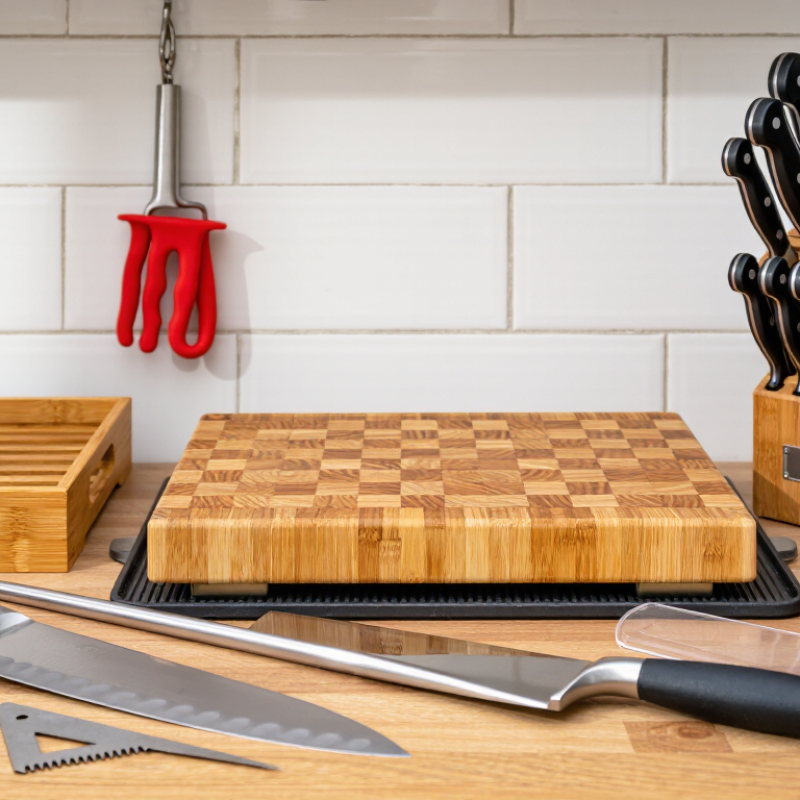
Top 10 Accessories That Improve Knife Performance
Essential Knife Accessories and Their Performance Benefits
Performance starts with edge control. A quality sharpening stone restores a dull edge without removing excessive metal. A honing rod realigns minor bends between sharpening sessions. An angle guide helps beginners maintain consistent contact with the stone. It is simple, but useful. A leather strop can refine the edge and remove tiny burrs. Use light pressure. Too much pressure may round the edge instead.
The cutting surface matters just as much. A resilient cutting board protects the edge better than glass or stone. A non-slip mat keeps the board steady during slicing. This small detail improves control and reduces awkward wrist movement. A protective sheath prevents edge damage during storage or transport. For home storage, a knife block or secure wall rack keeps blades separated. Crowded drawers are not ideal. They can cause accidental contact and gradual dulling.
Cleaning accessories also support performance. A soft cleaning cloth removes moisture and food residue before corrosion begins. Food-safe mineral oil helps protect suitable steel surfaces, especially in dry conditions. Apply only a thin layer. Excess oil attracts dust. My practical mistake was sharpening too often because the edge felt imperfect. A honing rod and better cutting board solved more problems than another aggressive sharpening session. Performance depends on the whole setup, not only the blade.
Essential knife accessories and their practical performance benefits
The performance score represents the practical impact of each accessory on edge sharpness, cutting consistency, safety, maintenance, and blade longevity. Sharpening tools, honing devices, cutting boards, storage systems, and cleaning equipment address different parts of overall knife performance.
A well-chosen cutting board can improve knife performance more than an expensive upgrade. In my kitchen, a firm wooden board gives controlled feedback without feeling harsh on the edge. Soft, food-safe plastic also works well, especially when raw ingredients require frequent cleaning. Avoid glass, stone, and ceramic surfaces. They can make an edge feel dull quickly. A board should stay stable, too. A damp towel underneath can prevent slipping during chopping.
Tips: Match the board to the task. Use a larger surface for rocking cuts, and keep a separate board for raw proteins. Wash and dry it promptly. Deep grooves may hold moisture and food residue, so replace damaged boards when cleaning becomes difficult.
A sheath protects the blade during drawers, travel, or shared kitchen storage. Choose one that covers the edge fully and holds the knife without pressure. The interior should remain dry; trapped moisture can encourage corrosion on some steels. Storage matters just as much. A rack, block, or magnetic system should keep the edge away from other metal tools. Never force a knife into a crowded slot. I once stored a sharp knife beside a peeler and found small scratches near the spine. That mistake was avoidable. I still check storage spaces before putting knives away. Good accessories do not replace careful technique, but they help preserve it.
A sharp knife works with less pressure, better control, and fewer crushed ingredients. In my kitchen, a sharpening stone restores a tired edge, while a honing rod corrects minor bends between sharpening sessions. The difference is visible when slicing a tomato: a clean cut replaces a ragged tear.
The U.S. Bureau of Labor Statistics reported more than 20,000 occupational injuries involving cuts and lacerations that required days away from work in 2022. This figure does not prove that dull knives caused those injuries. It does support careful maintenance and controlled handling. A medium-grit stone can remove damaged steel, but excessive pressure creates an uneven bevel. I still sharpen too aggressively sometimes. That mistake wastes metal.
A honing rod needs a light touch and a consistent angle, usually around 15 to 20 degrees per side for many kitchen knives. It should not replace stone sharpening when the edge feels genuinely blunt. Guided sharpeners can improve consistency for beginners because their angle control reduces guesswork. However, their fixed settings may remove more material than necessary. The National Institute for Occupational Safety and Health emphasizes engineering and work-practice controls for reducing hand injuries; stable cutting boards, dry handles, and deliberate movements remain essential. Test the edge on paper, not your finger. Small details matter.
| No. | Accessory | Typical Construction or Range | Performance Improvement | Recommended Use | Important Limitation |
|---|---|---|---|---|---|
| 1 | Medium-Grit Water Stone | Approximately 800–1,200 grit; abrasive surface used with water | Removes small amounts of metal efficiently and restores a dull working edge. | Routine sharpening of moderately dull kitchen and utility knives. | Requires a stable base and consistent sharpening angle; some stones need flattening. |
| 2 | Fine-Grit Finishing Stone | Approximately 3,000–8,000 grit; water-, oil-, or ceramic-based formats are available | Refines the edge, reduces coarse scratches, and can produce a smoother cutting feel. | Finishing an edge after medium-grit sharpening, especially for slicing tasks. | It removes metal slowly and cannot efficiently repair a severely damaged edge. |
| 3 | Diamond Sharpening Plate | Steel plate coated with diamond abrasive; commonly available from coarse to fine grades | Cuts hardened steels quickly and stays relatively flat during use. | Repairing chips, establishing a bevel, or sharpening wear-resistant knife steels. | Heavy pressure can remove metal too quickly and may shorten abrasive life. |
| 4 | Ceramic Honing Rod | Hard ceramic rod with a fine, smooth, or lightly abrasive surface | Realigns minor edge misalignment while removing a small amount of material. | Maintaining relatively sharp kitchen knives between full sharpening sessions. | Brittle if dropped; excessive pressure can abrade or damage a thin edge. |
| 5 | Smooth Steel Honing Rod | Polished hardened-steel rod with little or no abrasive texture | Helps realign a rolled edge without noticeably changing the blade bevel. | Frequent light maintenance on softer- or medium-hardness kitchen knives. | It will not sharpen a fully dull edge because it removes very little metal. |
| 6 | Guided Angle Sharpener | Abrasive surface paired with an angle guide, commonly offering fixed angles around 15°–25° per side | Improves consistency by helping maintain a repeatable edge angle on both sides. | Beginners, symmetrical double-bevel knives, and repeatable maintenance. | Fixed guides may not match unusual blade geometries or single-bevel designs. |
| 7 | Leather Strop | Firm leather strip, often used bare or with a fine polishing compound | Removes fine burr remnants and improves perceived smoothness after sharpening. | Final edge refinement after stones or guided sharpening systems. | Too much pressure can round the apex and reduce cutting aggression. |
| 8 | Flattening Plate | Flat abrasive plate designed to restore the working surface of water stones | Keeps a sharpening stone flat, supporting more uniform bevel contact and angle control. | Maintaining frequently used water stones, especially softer stones. | It is intended for stone maintenance, not for routine sharpening of the knife itself. |
| 9 | Non-Slip Stone Base | Rubber, silicone, or clamping holder that stabilizes a sharpening stone | Reduces stone movement, making strokes safer and helping preserve a consistent angle. | Manual sharpening on countertops, workbenches, or other flat surfaces. | The base must match the stone dimensions and should be kept free of oil or water buildup. |
| 10 | Angle Guide Clip | Small clip that references the spine of the blade to help set a repeatable angle | Provides a visual and physical reference for users learning manual stone sharpening. | Straight-edged blades with enough spine thickness for secure clip placement. | It may scratch delicate finishes or interfere with thick, flexible, serrated, or unusually shaped blades. |
A well-chosen accessory can make a knife feel safer, steadier, and more predictable. In my experience, the handle matters most. Textured sleeves, replacement scales, and slim grip tape can reduce slipping when hands are wet. Choose a shape that fills the palm without forcing your fingers tightly together. Oversized grips often create fatigue. Small details matter.
A finger guard adds a physical stopping point near the blade. It can improve control during careful cutting, but it cannot replace proper technique. A lanyard hole, secure sheath, and compact storage case also help prevent careless handling between tasks. For maintenance, use a clean cloth, a small brush, and a suitable pivot lubricant on folding mechanisms. Apply only a tiny amount, then wipe away excess residue. Too much lubricant attracts dust and may reach areas where it does not belong. Use only products approved for the knife’s materials and intended environment.
I once added a thick grip sleeve that felt comfortable at first. After several minutes, it restricted my wrist movement. That was a useful mistake. Comfort should be tested during realistic work, not judged from a quick inspection. Check guards for cracks, handles for looseness, and sheaths for secure retention. Replace damaged parts promptly. A sharp edge, controlled grip, and clean mechanism usually work better together than any single accessory.
A knife performs better when its accessories support routine care, not just sharpening. In my workshop, I keep a soft microfiber cloth, a small nylon brush, mild dish soap, and a shallow drying tray nearby. These simple tools remove food residue, dust, and fine grit without scratching the surface. A wooden toothpick can clear debris from narrow joints, but it must be used gently.
Keep it dry.
For folding knives, a compact screwdriver set helps inspect loose fasteners. A small flashlight reveals buildup around the pivot and handle seams. A magnifying glass can expose tiny chips, uneven bevels, or early corrosion. After washing, I dry every area immediately, especially near hinges and hidden recesses. A light, food-safe lubricant may protect moving parts, but excess oil attracts dust and can reach surfaces that contact food.
Inspection should happen under bright, direct light. I check the edge for rolling, cracks, and dull patches before choosing a sharpening tool or ceramic honing rod. A blade guide can improve consistency, although it may encourage careless pressure. I have sometimes cleaned a knife too quickly and missed grit inside the pivot. That mistake taught me to open, inspect, and wipe slowly when the design allows it. Always follow the maker’s care instructions, because materials and construction can react differently to water, heat, and cleaning products.
A quality sharpening stone removes limited metal while restoring the edge. Use steady, moderate pressure. Sharpening too aggressively can shorten the blade’s useful life.
A honing rod realigns small bends between sharpening sessions. It does not replace full sharpening. Use it gently and check the edge afterward.
An angle guide helps beginners keep consistent contact with the stone. Consistency matters more than speed. Excessive pressure can still damage the edge.
A resilient cutting board is kinder to the edge than glass or stone. A non-slip mat keeps the board steady. That small detail improves wrist control.
Use a protective sheath, separated storage block, or secure wall rack. Avoid crowded drawers. Blade contact can cause dulling and accidental handling.
Textured sleeves, replacement scales, and slim grip tape can reduce slipping. Choose a handle that fills the palm comfortably. Oversized grips may cause fatigue.
Use a small brush, clean cloth, and a tiny amount of suitable lubricant. Wipe away excess residue. Too much oil attracts dust.
A microfiber cloth, nylon brush, mild soap, and drying tray remove residue gently. Dry hidden joints immediately. Keep it dry.
Inspect the edge, handle, guard, sheath, fasteners, and pivot under bright light. Look for chips, looseness, cracks, and corrosion. I once cleaned too quickly and missed grit inside a joint.
Replace damaged guards, loose handles, and insecure sheaths promptly. Test comfort during realistic work, not only during a quick inspection. My thick grip sleeve felt good initially, but restricted wrist movement later.
This guide explains what accessories improve knife performance and how each one contributes to safer, smoother, and more efficient cutting. A suitable cutting board protects the blade edge, while a well-designed sheath and storage system prevent accidental damage and keep the knife secure. Sharpening stones, honing rods, and guided sharpeners serve different maintenance purposes, helping restore sharpness, refine the edge, and maintain consistent results over time.
The article also explores accessories that improve grip and control, including ergonomic handles, protective guards, and suitable lubricants for moving or exposed parts. Regular cleaning, careful drying, periodic inspection, and proper storage are equally important for preserving performance. By selecting accessories according to the knife’s material, intended use, and maintenance needs, users can reduce wear, improve handling, and extend the useful life of their knives.

Eco Best Kitchens