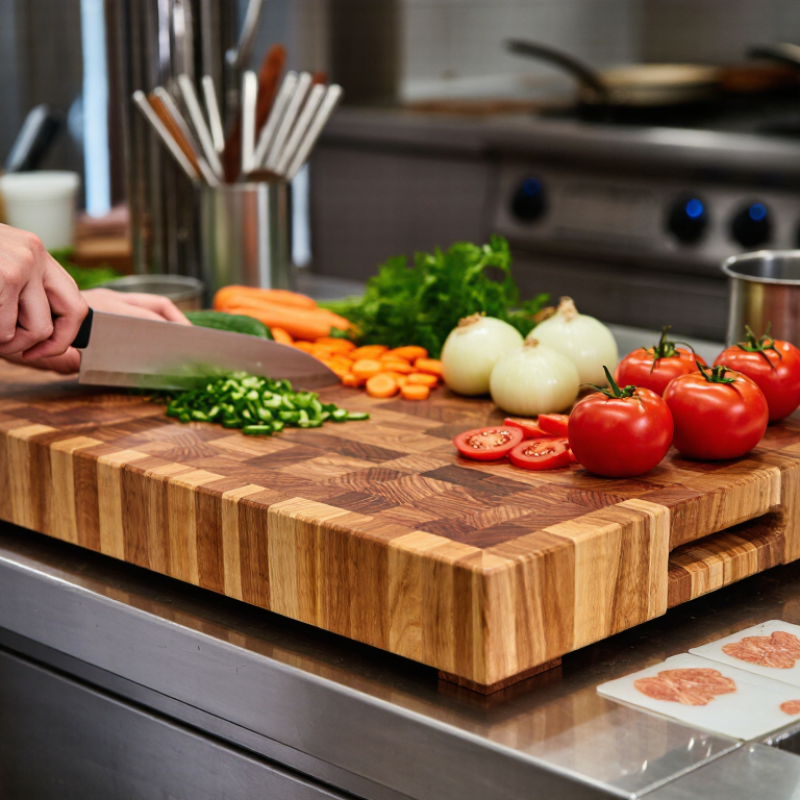
A busy kitchen reveals the value of a cutting board quickly. Knives land hard, ingredients pile up, and the next order is already waiting. That pressure helps explain why butcher block boards are preferred in professional kitchens. Their substantial construction can provide a steady work surface for repeated chopping, slicing, and portioning. A board that stays put matters when a cook is moving fast.
There are practical reasons behind the preference. End-grain and edge-grain designs can be durable, while wood may feel gentler on knife edges than very hard surfaces. A thick board also absorbs some impact and offers room for prep work. Scratches and shallow marks can sometimes be sanded away, extending a board’s useful life. Looks count, too: warm wood can make a prep station feel less stark. But appearance is not the whole story.
Care matters. Wood needs thorough cleaning, prompt drying, and regular conditioning with food-safe oil, according to the maker’s instructions. It should not be left soaking beside a sink. Nor does every kitchen use the same board policy; surface choice and handling procedures should fit the operation’s food-safety plan. That matters. Butcher block is not maintenance-free, and a neglected board can become a liability rather than an asset. The familiar appeal is real, yet it can make people underestimate the work. The best boards earn their place through reliable performance, sensible upkeep, and a good fit for the kitchen’s daily routine.
FDA Food Code §4-101.17: The Hard-Maple Exception for Cutting Boards
FDA Food Code §4-101.17 makes a specific allowance: hard maple, or equivalent close-grained wood, may be used for cutting boards and blocks. That is not blanket approval for every wooden board. Food-contact surfaces must remain durable, smooth, and easily cleanable. In practice, deep knife grooves, lifted fibers, and split seams can undermine those qualities. The material exception has limits.
For busy kitchens, the distinction matters. A hard-maple board can take repeated knife work, but it still needs careful inspection and cleaning. The FDA’s 2022 Food Code §4-602.11(E) generally calls for food-contact surfaces used with time/temperature control for safety foods to be cleaned at least every four hours, subject to listed exceptions. That is a useful operational benchmark, not a substitute for a kitchen’s approved procedures. Wood is not magic.
Choose a board with tight, even grain and stable, well-joined construction. Keep raw-protein prep separate from ready-to-eat foods, and remove a board from service when it becomes deeply scored or difficult to clean. USDA FSIS consumer guidance likewise recommends separate boards for raw meat, poultry, and seafood versus produce and bread. Maple’s regulatory allowance is useful; the daily inspection is easy to overlook.
5 Best Reasons Pro Kitchens Prefer Butcher Block Boards
Hardness of common domestic hardwoods, shown as typical Janka values in pounds-force (lbf).
Why it matters: Hard maple combines a comparatively hard surface with a close-grained structure. FDA Food Code §4-101.17 allows cutting boards made of hard maple or an equivalent close-grained material, provided the material also meets §4-101.11. The Food Code does not set a Janka hardness threshold; these figures compare wood species, not food-code compliance. Actual hardness varies with the wood.
Janka hardness is measured by the force needed to embed a steel ball halfway into the wood. Values shown are typical published species averages.
The Wood Database: Hard Maple’s 1,450-lbf Janka Hardness Rating
Hard maple’s 1,450-lbf Janka rating is a useful measure of resistance to denting, not a promise that a board will stay mark-free. The Wood Database reports this rating for hard maple, commonly identified as sugar maple. In the Janka test, a steel ball is pressed into wood until half its diameter is embedded. That gives kitchen teams a comparable hardness figure. It does not measure knife-edge wear, sanitation, or long-term performance in a busy kitchen.
The USDA Forest Products Laboratory’s Wood Handbook reports sugar maple density at about 705 kg/m³ at 12% moisture content. That dense structure helps explain why a maple board can handle repeated chopping and contact with heavy cookware. On a prep table, it feels firm under a chef’s knife; small cuts may still appear over time. That’s normal.
Hardness has trade-offs. A board that resists deep dents may feel less forgiving than a softer wood surface, and no Janka score prevents cracking from poor drying or neglect. Wash promptly, dry both faces, and apply food-grade mineral oil when the surface looks thirsty. I’d still inspect seams and deep grooves regularly; the rating alone cannot tell you when a board needs attention.
5 Best Reasons Pro Kitchens Prefer Butcher Block Boards - The Wood Database: Hard Maple’s 1,450-lbf Janka Hardness Rating
| Reason |
Supporting fact |
Practical kitchen value |
| 1. A durable hardwood option |
Hard maple has a Janka hardness rating of about 1,450 lbf. The Janka test measures resistance to indentation by a steel ball. |
Its hardness makes it a practical choice for a frequently used cutting surface. The rating is not a measure of knife sharpness or bacterial resistance. |
| 2. A repairable solid-wood surface |
A solid-wood board with enough material remaining can generally be sanded to refresh a worn or marked surface. |
Refinishing can extend a board’s useful life; the amount that can be removed depends on its thickness and construction. |
| 3. A choice of grain orientation |
Edge-grain boards show the long edges of the wood strips, while end-grain boards show the ends of the fibers. |
Kitchens can select a construction to suit their preferred appearance, board weight, and budget. Both styles require appropriate cleaning and care. |
| 4. A substantial, stable work surface |
Butcher-block boards are made in a range of thicknesses and sizes; greater thickness generally means greater board weight when other dimensions are similar. |
A suitably sized, heavier board can provide a steady-feeling station for repeated prep. A damp towel or non-slip mat can help reduce movement. |
| 5. Straightforward care routines |
Wood boards should be washed after use, dried promptly, and not left soaking. Food-grade mineral oil is commonly used to help condition unfinished wood. |
Consistent cleaning and drying help limit moisture-related warping and cracking. Follow the board maker’s care instructions, especially for glued or finished boards. |
Note: Janka values are species-level reference figures; natural variation means individual pieces of wood may differ.
End-Grain Construction: How Wood Grain Helps Cushion Knife Impact
In an end-grain butcher block, the wood fibers stand upright, like a bundle of short straws. A knife meets their ends rather than slicing across long, flat fibers. Under pressure, those fibers can flex slightly and part around the blade. The contact often feels less jarring than on a hard, flat surface.
That small difference matters during repeated prep. Chopping onions, herbs, or firm vegetables sends a steady rhythm through the knife and board. End grain can absorb some of that impact, helping the edge avoid unnecessary harsh contact. It is not a cure for dull knives. Nor does it make careless chopping safe. The board still needs a stable, level surface.
There is a trade-off. The cut fibers may show knife marks, and the board needs sensible care: wash it promptly, dry it well, and avoid leaving it submerged. A light food-safe oil treatment can help limit drying and cracking. Even with good care, marks will accumulate. That is part of the board’s working surface, not proof of failure. Still, end grain is not automatically the best choice for every kitchen; its weight and upkeep can feel like a nuisance on a busy day.
FDA Food Code §4-202.11: Cleanability Standards for Reusable Boards
5 Best Reasons Pro Kitchens Prefer Butcher Block Boards
FDA Food Code §4-202.11: Cleanability Standards for Reusable Boards
FDA Food Code §4-202.11 focuses on whether reusable food-contact surfaces can be cleaned effectively. Surfaces should be smooth and free of cracks, open seams, chips, pits, and similar defects. The rule is about cleanability, not a blanket endorsement of every wooden board. Local requirements may vary.
Wood is addressed separately in §4-101.17, which permits cutting boards made from hard maple or an equivalent hard, close-grained wood. In daily kitchen use, that distinction matters. A dense board can provide a stable cutting surface, but deep knife grooves can trap residue and make cleaning harder. Inspect the board under bright light. Look closely at the center, edges, and any glued joints.
Small marks happen. Deep damage is different. Scrape away food debris, wash the board with the kitchen’s approved procedure, then sanitize it as required. Let it dry fully before storage; a damp board tucked flat against a counter may stay wet underneath. Replace or repair boards that develop persistent cracks, loose joints, or rough pits. Even well-kept wood needs honest inspection. A familiar board is not automatically a cleanable one.
Commercial Board Selection: Comparing Durability, Maintenance, and Service Life
Commercial kitchens should compare cutting boards by surface condition, sanitation workload, and repairability—not purchase price alone. The 2022 FDA Food Code permits hard maple or equivalent close-grained wood for cutting boards, provided surfaces remain smooth and free of cracks (Section 4-101.17). It also sets a practical cleaning benchmark: food-contact surfaces used with time/temperature control for safety foods generally require cleaning at least every four hours (Section 4-602.11). That schedule can shape staffing and board rotation. A heavy butcher block stays steady during repetitive chopping, but it needs regular inspection and suitable resurfacing when knife grooves deepen. Small details matter.
Plastic boards are lighter and often easier to route through commercial dishwashing, while thick wood blocks can be sanded and returned to service if their condition allows. Neither material is maintenance-free. The FDA code sets no universal service-life number, so a fixed replacement schedule would be misleading. Track cracks, warping, persistent stains, and grooves that resist cleaning; remove boards that cannot be restored to a cleanable surface. Follow the board maker’s care instructions, and keep raw-protein and ready-to-eat work separated. A little inconvenient, perhaps, but useful: record purchase dates and repairs. Comparing that log with replacement frequency gives operators a more credible service-life estimate than a generic “years of use” claim.
Conclusion
Professional kitchens often choose butcher block boards because they balance durability, knife care, and practical sanitation. FDA Food Code §4-101.17 recognizes hard maple and other close-grained woods as suitable for certain cutting surfaces. Hard maple’s Janka hardness rating of about 1,450 lbf indicates a firm, wear-resistant surface, while its close grain helps limit deep scoring during regular use. End-grain construction adds another advantage: the wood fibers can give slightly under a blade, helping cushion knife impact and reduce wear on both knives and the board.
Cleanability and upkeep also matter in a busy kitchen. Under FDA Food Code §4-202.11, reusable food-contact surfaces must be smooth and easily cleanable, so board condition and maintenance are important considerations. When comparing materials, kitchens weigh durability, cleaning routines, repair needs, and expected service life. Together, these factors help explain why butcher block boards are preferred in professional kitchens: they can offer a long-lasting, knife-friendly work surface when properly maintained.

 Eco Best Kitchens